by Elizabeth Lovero
Quality control is one of the biggest challenges facing data management firms, especially those that rely on crowdsourced resources for some or all of their production. In an effort improve worker skills and accuracy for crowdsourced projects, I conducted a study under Dr. Matt Lease at the University of Texas at Austin’s Crowdsourcing Lab earlier this year and found that workers who completed an online course in advance of starting work produced measurably more accurate results on data refinement tasks. Expanding on these results, I built a Crowdlearning Center for Information Evolution, Inc. (IEI) to train and certify workers in IEI research protocols.
IEI’s Crowdlearning Center hosts Small Private Online Courses (or SPOCs) that teach data refinement skills to contractors worldwide and internal teams as well. Based on the Moodle open-source learning management system, each self-paced course features a guided learning path of resources and activities. The Crowdlearning Center enables IEI to train an agile workforce that produces high-quality output and adapts quickly to changing market demands.
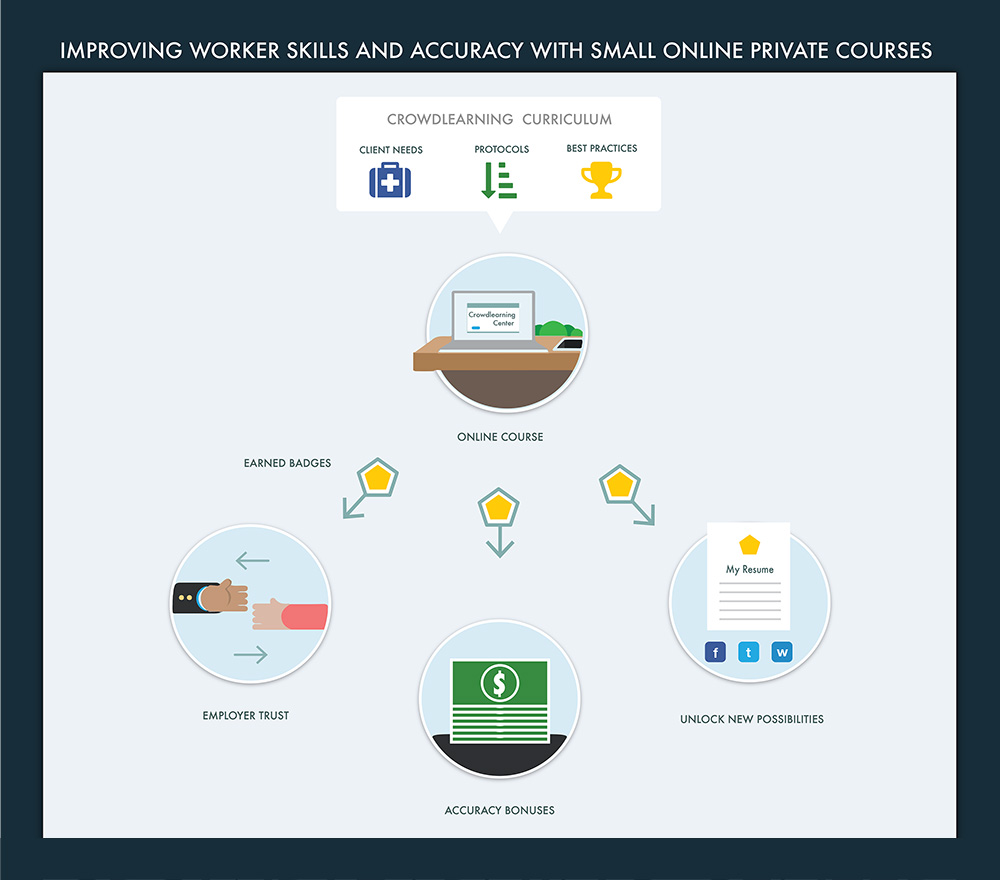
Clients are not the only ones to benefit from a Crowdlearning Center. Workers who complete the SPOC lessons and earn at least 90% on the final unit test are awarded a badge that certifies their skills. The badges are built on the Mozilla Open Badges framework and registered with Cred.ly.
Each badge links back to the issuer, the issuing criteria, and the evidence verifying the credential. Workers can display their badges on the web and share them for employment, education, and lifelong learning. The Mozilla Open Badges standard enables individuals to combine badges from any of the 1,000+ issuers to tell the story of their achievements.
In the Wild West of online labor markets, badged workers are better able to gain employer trust, earn accuracy bonuses, and see continued opportunity. Allowing workers to build their skill sets and demonstrate that they have done so makes credentialed projects more attractive to high-performing resources and build a stable foundation for data teams and the firms that employ them to grow and prosper.
posted by Shyamali Ghosh on August 11, 2014
by Matt Manning
It’s no surprise to anyone that print directories are being retired in the face of the seismic shift to electronic information services. I’m not one to wax nostalgic about this, especially since I’ve worked hard to bring about this shift! Since many of us are participating in this publishing industry history in the making I think it’s surprisingly informative to take a look at exactly how that shift is taking place.
- CQ Press’s Worldwide Governmental Directory was discontinued in 2013 along with its electronic version (World Powerbase). Despite its reliable, deep data and consistent structure it lost out to indirect competition from the loosely structured free web (Wikipedia, etc.).
- The World Aerospace Database, published for decades as the World Aviation Directory, was a massive industry compendium that pushed the limits of perfect binding for years. It was rolled into the online Aviation Week Intelligence Network portal in 2012 where it now provides a rock-solid foundation for the service.
- HEP, Inc. has published the Higher Education Directory for 30 years and the print product still perseveres along with its electronic adjuncts. The universe of higher education organizations in the US continues to grow, but the print product’s page count stays consistent because low-usage data is regularly pared from the print product. Cross-references direct users to this data at the company’s online properties.
- Contractors Register offers free, advertising-supported print directories of construction industry subcontractors to general contractors in dozens of regional editions. First printed over 100 years ago, all editions are still offered in print. Certain market sub-segments with demonstrably low usage of the print products and high usage of online services are being gradually dropped from the circulation lists. This reduces the number of copies printed every year, but maintains the products’ market “reach.”
These experienced business-to-business publishers’ different approaches show the resilience of publishing product managers in the face of major change. Everyone met similar, but not the exact same, challenges based on their products’ market position, renewal and usage data, production costs, and the unique markets they served. Their decisions show that change is not a matter of making simple yes/no decisions. Rather, complex analyses led to specific, often phased, long-term series of actions.
New products and start-ups may get more “ink” than established products, but there is life-and-death innovation going on in the trenches of our ever-changing industry.
posted by Shyamali Ghosh on August 4, 2014