by Matt Manning
The models for information services are based on two basic revenue streams: advertising and subscriptions. There are a few free services based on donations (a loosey-goosey form of subscription), some pay-per-use services (a limited form of “subscription”), and a lot of services that blend the two streams in different proportions. So where does “open data” fit in to all of this?
Right now open data is primarily driving government information services. The model for these services is “free,” meaning they were built by private companies like Socrata and paid for by your tax dollars, but there is absolutely no reason open data sets could not be used by private firms to build more robust and feature-rich information services.
Key to making this happen is a new breed of open data evangelists in academia and nonprofits. These tech-savvy data scientists are busily connecting the dots that allow data that is “available,” but virtually unusable, into APIs that allow the level of granularity, normalization, and accessibility required to create functional information services. MIT’s Billion Prices Project, ProPublica, and Open Corporates are just three of these invaluable “middlemen” tapping donations, grants, and crowdsourcing to make open data more than just a promise.
As these APIs proliferate it is very likely that the private sector will jump in to create hundreds of new services. This intense competition due to the lower “barrier to entry” may lead to a generation of free, ad-supported services with add-on pay-per-use services associated with them. This in turn raises the bar for functional sophistication and could mean that we are in for a true renaissance of the promise of the Internet (deep, interlinked data, with minimal barriers to access) and the spoils of success going to those with the most functional and creative software.
posted by Shyamali Ghosh on February 18, 2014
By Kevin Dodds
Recently, I had the honor of delivering a guest lecture at The Information School at The University of Texas in Austin, which is proudly my alma mater. The class was Human Computation & Crowdsourcing, taught by Dr. Matt Lease. It was a sincere privilege for me and for IEI to join his students for an afternoon class.
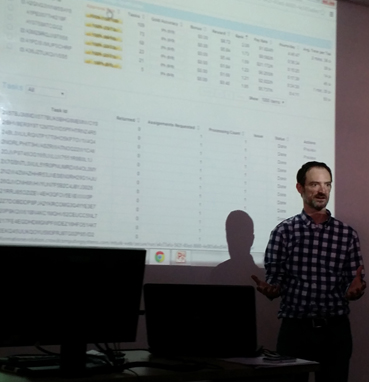
A few years ago, I joined Information Evolution as a senior project manager. My main objective at the time was to figure out how to use crowdsourcing for everyday data collection. I understood the concepts of crowdsourcing but was unfamiliar with the mechanics, and it would still be several years before Crowdsourcing for Dummies (2013) hit the shelves. I charted my own course through the learning curve, and the navigation was often very tricky.
Today, I have the benefit of several years of managing crowdsourcing projects in the business world. My recent experience at The University of Texas allowed me to peek inside the academic world—and it is vibrant and exciting. During this lecture, students:
- Viewed a real-time crowdsourcing language experiment
- Discussed their recent experiences as actual Turkers
- Exchanged views on crowdsourcing ethics
- Reviewed scamming practices
My presentation included a review of the mechanics of crowdsourcing and some real-world business applications, which led to a fascinating discussion. I absolutely learned a thing or two myself.
These students are the crowdsourcing managers of the future. They have access to vast amounts of study and practical application. Considering that the field is so new, these men and women will truly change the way work is done in the future.
Crowdsourcing is fascinating because it is a work process that is evolving and changing right before our eyes. When today’s students enter the working world, their valuable knowledge and steady this unwieldy ship. Their navigation and control will drive powerful and positive changes in the field of data collection to the economic benefit of businesses and workers around the world.
posted by Shyamali Ghosh on February 14, 2014